
Shaker Filters
Home » Products » Shaker Filters
Shaker Filters
Rugged, low-maintenance bag filtration for wood waste — cleaned automatically every time the fan stops.
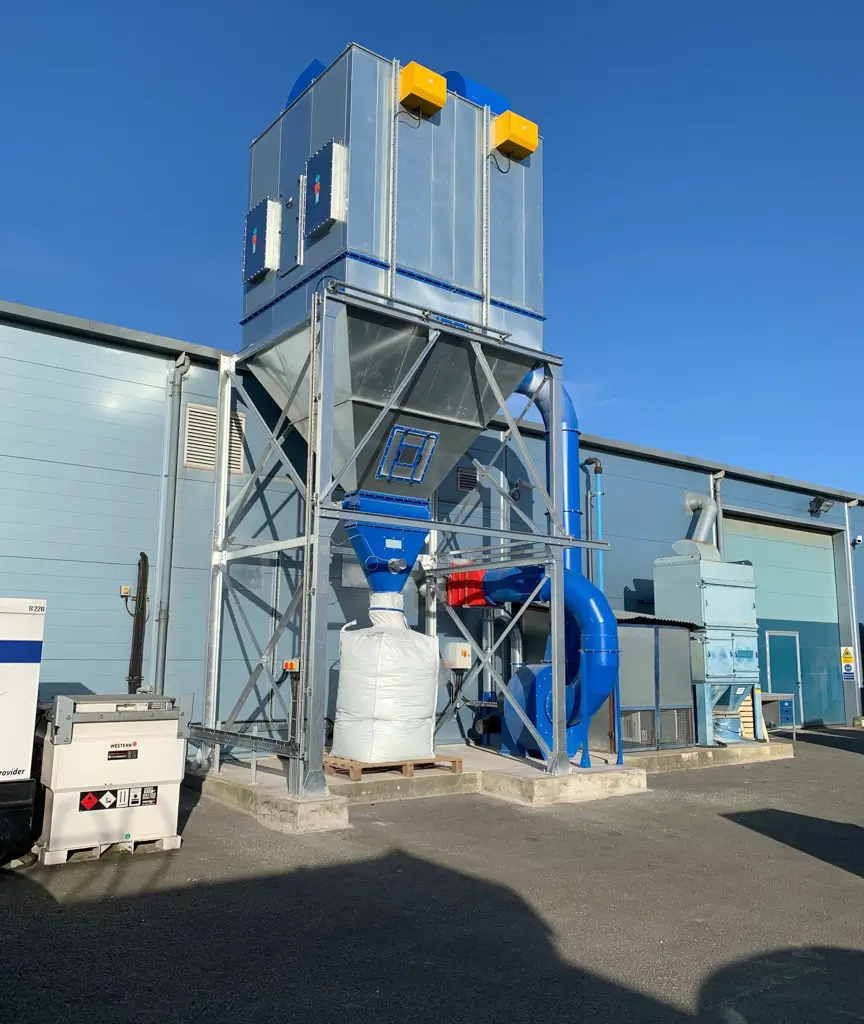
The Dustrax No.27 is a modular shaker bag filter for medium to large wood-waste dust extraction systems. Large tubular filter sleeves handle coarse particulate and reduce the risk of bridging and blocking. Heavier chips and shavings fall straight into the hopper, while finer dust is captured on the inside of the sleeves. An integrated electric shaker cleans the sleeves automatically whenever the extraction fan stops, keeping maintenance simple and suction consistent.
The No.27 is built from standard filter sections, each with 27 m² of filter cloth to suit the airflow of your process, from 2 up to 8 sections (around 7,000 to 28,500 m³/h). The name itself comes from that cloth area, each section holds 18 tubular sleeves of 1.5 m² each, giving 27 m². It is offered with two waste discharge arrangements: a hopper with a rotary valve that discharges into a skip, bulker bag, silo or pneumatic transfer system, or a bagging base that discharges straight into collection sacks. For wood waste, anti-static polyester needle-felt media is supplied as standard. Cleaned air can be recirculated into the building or vented outside. Every unit is UK-built and factory tested by Dustraction before installation.
Select a variant:
- Hopper outlet accepts a Dustrax 350 series rotary valve airlock.
- Discharges into a skip, bulker bag, silo or dump bunker, or into a pneumatic transfer system.
- Raised on a support stand: approx. 1.8 m clearance for a skip or 1.13 m for a bulker bag (2-section units).
- Filter assessed for ATEX Equipment Group II, Category 3, Zone 22 (Ex II 3 D).
- Explosion relief panels are fitted to the filter (vent area scales with size — see notes).
- Optional rotary blockage sensors give early warning of a back-up.
- Waste discharges by gravity straight into heavy-gauge collection sacks.
- Choose an enclosed bagging base (sacks housed in a cabinet) or open bagging.
- Sacks are held securely with bagging clamp straps.
- A 2-section unit is 1860 × 1520 mm in plan and approx. 4.4 m high.
- No rotary valve or moving parts beneath the filter.
- Same filter body as the rotary valve unit: ATEX Zone 22 (Ex II 3 D), with explosion relief panels fitted.
70 years UK engineering
Est. 1955
UK manufactured
& factory tested
COSHH / LEV / ATEX
compliant by design
EMDA Member
industry association
Running after 50 years
proven longevity
Overview
Modular shaker filtration for wood waste
| Industries | Woodworking |
| Materials | Dry wood chip, shavings and wood dust (non-conductive). The No.27 is for wood waste only; only the dust specified to Dustraction should be extracted. |
| System size | Medium to large extraction systems; modular sections (2–8) scaled to the required airflow |
| Duty cycle | Processes with regular stops (breaks, shift ends) during which the shaker cleans the sleeves |
| Typical outcome | Clean, low-maintenance extraction with waste collected in a skip, silo, bulker bag or sacks, and cleaned air recirculated or vented |
How it Works
Key Features & Benefits

Product Anatomy
Select a variant:
Schematic Diagram
Shaker Filter
Explore the system in 3D. Select a component to see where it sits and what it does.
Loading 3D model…
Product Specifications
| Filter Size | Maximum Airflow m³/h | Plan Dim "A" (mm) | Height Dim "B" (mm) | No. Sleeves |
|---|---|---|---|---|
| No.27 2-section | 7128 | 1860 × 1520 | 4390 / 4410 | 36 |
| No.27 3-section | 10692 | 2680 × 1520 | 4390 / 4410 | 54 |
| No.27 4-section | 14256 | 3500 × 1520 | 4390 / 4410 | 72 |
| No.27 6-section (2×3) | 21384 | 2680 × 3040 | 4390 / 4410 | 108 |
| No.27 8-section (2×4) | 28512 | 3500 × 3040 | 4390 / 4410 | 144 |
Select a variant:
| Specification | Value |
|---|---|
Filter type | Modular mechanical shaker bag filter (No.27 SRV series) |
Construction | Modular filter sections on steel support stand with pyramid hopper, 2 to 8 sections (2, 3, 4, 6 and 8 standard; 5-section on request) |
Filter media | Anti-static polyester needle-felt tubular sleeves, Ø200 × 2355 mm (standard for wood waste) |
Cloth area | 27 m² per section (18 sleeves × 1.5 m²); e.g. 2-section = 54 m², 8-section = 216 m² |
Filtration efficiency | 99.996% overall collection efficiency by mass (Dustraction standard cloth test); 99.995% on particles > 10 µm and 99.5% < 10 µm (standard polyester felt — anti-static grade equivalent) |
Maximum airflow | Air-to-cloth ratio 2.2 m³/min per m² — 3,564 m³/h per section (2-section 7,128 … 8-section 28,512 m³/h; see size table) |
Sleeve cleaning | Automatic mechanical shaker; runs approx. 20–30 seconds each time the main fan stops |
Shaker drive | Mechanical shaker; motor sized to the unit (e.g. 0.18 kW on a 2-section), V-belt driven eccentric crank |
Rotary valve | Dustrax 350 series rotary airlock valve, rubber-tipped rotor blades, geared motor drive |
Waste discharge | Gravity into skip, bulker bag, silo or dump bunker; or pneumatic transfer to remote silo / container |
Extraction fan (reference) | Dustrax No.30 paddle blade fan, direct driven: 7.5 kW (to skip) / 11 kW (to bulker bag) in 2-section reference — fan sized to each application |
Fan starting | DOL starter up to 7.5 kW; star-delta from 11 kW (sized to the fan motor) — see Control Panels & Starters |
Plan dimensions (2-section) | 1860 × 1520 mm (excluding fan) |
Overall height (2-section) | 6884 mm (to skip) / 6314 mm (to bulker bag) |
Clearance under discharge | 1800 mm (skip) / 1130 mm (bulker bag) |
ATEX | Equipment Group II, Category 3, Zone 22 (Ex II 3 D); filter assessed to BS EN 13463-1 (ignition hazard assessment to EN 1127-1) |
Explosion protection | Explosion relief panels (1000 × 666 mm, 0.53 m² each): 1 on 2-section, 2 on 3/4-section, 3 on 6-section; vented to a safe designated area |
Design dust basis | Non-conductive dust; MIE > 3 mJ; cloud ignition temp > 187 °C; layer ignition temp > 200 °C (unless specified otherwise) |
Clean air | Recirculated into the building or vented outside |
| Feature | StandardStd | OptionalOpt |
|---|---|---|
Automatic shaker cleaning Starts automatically when the main fan stops and runs for approx. 20–30 seconds, dislodging dust from the inside of the sleeves into the hopper. | ✓ | |
Anti-static needle-felt sleeves Polyester needle-felt sleeves, Ø200 × 2355 mm, 18 per section (1.5 m² each = 27 m²); anti-static grade for explosive wood dust; a spring-steel hoop seals each sleeve into the spigot plate. | ✓ | |
Rotary valve airlock Meters waste out of the hopper while sealing the filter, preventing air leakage, loss of suction and blow-back of dust. | ✓ | |
Support stand & hopper Raises the filter to give clearance for a skip, bulker bag or conveying system beneath. | ✓ | |
Discharge chute / flexible sleeve Directs waste from the rotary valve into the skip or bulker bag with minimal spillage. | ✓ | |
Explosion relief panels Vent the force of a potential deflagration safely away from personnel; number of panels scales with filter size. | ✓ | |
Explosion panel limit switch (ATEX rated) Signals a panel rupture to the control system. | ✓ | |
ATEX Zone 22 rated motors Available where the risk assessment requires (motors are external to the filter and outside the airstream as standard). | ✓ | |
Rotary blockage sensors Fitted in the hopper and below the rotary valve; warn of a blockage or overfull container before waste backs up. | ✓ | |
Hopper inspection window Lets operators check the hopper is clear without opening the unit. | ✓ | |
VigiFlap explosion isolation flap Passive flap valve in the inlet duct that stops an explosion travelling back along the ductwork — the same VigiFlap isolation damper used on the Cyclo Filter. | ✓ | |
Pneumatic transfer plant Transfer fan and loop duct convey waste to a remote silo or container via a cyclone and rotary valve; interlocked with the extraction plant. | ✓ | |
Filter gauge Gives a visual indication of how loaded the sleeves are, so a shutdown and shake can be triggered at a set level. | ✓ | |
Control panel Designed to integrate with the site supply; integral isolator, emergency stop and function lights available as extras. | ✓ | |
Return-air (recirculation) duct Returns cleaned air to the building; a fire damper is fitted in the return-air duct when supplied. | ✓ |
| Specification | Value |
|---|---|
Filter type | Modular mechanical shaker bag filter (No.27 series) |
Construction | Modular filter sections, 2 to 8 sections (2, 3, 4, 6 and 8 standard; 5-section available on request) |
Filter media | Anti-static polyester needle-felt tubular sleeves, Ø200 × 2355 mm (standard for wood waste) |
Cloth area | 27 m² per section (18 sleeves × 1.5 m²); e.g. 2-section = 54 m², 8-section = 216 m² |
Filtration efficiency | 99.996% overall collection efficiency by mass (Dustraction standard cloth test); 99.995% on particles > 10 µm and 99.5% < 10 µm (standard polyester felt — anti-static grade equivalent) |
Maximum airflow | Air-to-cloth ratio 2.2 m³/min per m² — 3,564 m³/h per section (2-section 7,128 … 8-section 28,512 m³/h; see size table) |
Sleeve cleaning | Automatic mechanical shaker; runs approx. 20–30 seconds each time the main fan stops |
Shaker drive | Mechanical shaker; motor sized to the unit (e.g. 0.18 kW on a 2-section), V-belt driven eccentric crank |
Waste discharge | Gravity discharge into heavy-gauge collection sacks (enclosed bagging base or open bagging) |
Extraction fan (reference) | Dustrax No.30 paddle blade fan, direct driven, 7.5 kW (2-section reference) — fan sized to each application |
Fan starting | DOL starter up to 7.5 kW; star-delta from 11 kW (sized to the fan motor) — see Control Panels & Starters |
Plan dimensions (2-section) | 1860 × 1520 mm (excluding fan) |
Overall height (2-section) | 4390 mm (enclosed bagging base) / 4410 mm (open bagging) |
ATEX | Equipment Group II, Category 3, Zone 22 (Ex II 3 D); filter assessed to BS EN 13463-1 (ignition hazard assessment to EN 1127-1) — same filter body as the rotary valve variant |
Explosion protection | Explosion relief panels (1000 × 666 mm, 0.53 m² each): 1 on 2-section, 2 on 3/4-section, 3 on 6-section; vented to a safe designated area |
Design dust basis | Non-conductive dust; MIE > 3 mJ; cloud ignition temp > 187 °C; layer ignition temp > 200 °C (unless specified otherwise) |
Clean air | Recirculated into the building or vented outside |
| Feature | StandardStd | OptionalOpt |
|---|---|---|
Automatic shaker cleaning Starts automatically when the main fan stops and runs for approx. 20–30 seconds, dislodging dust from the inside of the sleeves into the hopper. | ✓ | |
Anti-static needle-felt sleeves Polyester needle-felt sleeves, Ø200 × 2355 mm, 18 per section (1.5 m² each = 27 m²); anti-static grade for explosive wood dust; a spring-steel hoop seals each sleeve into the spigot plate. | ||
Enclosed bagging base Houses the collection sacks inside a cabinet with an access door for a tidy, contained discharge. | ✓ | |
Open bagging Sacks hang directly beneath the hopper outlets for the simplest, most accessible arrangement. | ✓ | |
Bagging clamp straps Secure each collection sack to its hopper outlet. | ✓ | |
Filter case access doors Allow internal inspection of the sleeves and spigot plate (plant isolated). | ✓ | |
Filter gauge Gives a visual indication of how loaded the sleeves are, so a shutdown and shake can be triggered at a set level. | ✓ | |
VigiFlap explosion isolation flap Passive flap valve in the inlet duct that stops an explosion travelling back along the ductwork — the same VigiFlap isolation damper used on the Cyclo Filter. | ✓ | |
Control panel Designed to integrate with the site supply; integral isolator, emergency stop and function lights available as extras. | ✓ | |
Return-air (recirculation) duct Returns cleaned air to the building; a fire damper is fitted in the return-air duct when supplied. | ✓ |
Total Cost of Ownership
Simple mechanics, low running costs
The No.27 keeps running costs down by keeping things simple. Sleeve cleaning is done by a small shaker motor that runs for well under a minute each time the fan stops, so there is no compressed air supply to install, run or maintain. Routine upkeep is limited to a monthly visual check of the sleeves, periodic greasing and belt checks on the shaker, and — on rotary valve units — six-monthly checks of the rotor seals.
Sleeve life depends on the dust type and loading, the cleaning regime and moisture, but correct sizing and regular shake-downs give long, stable service. Where cleaned air is returned to the building, less heated air is lost to atmosphere than when venting outside. Dustraction supports every installation with LEV testing, servicing and a stock of recommended spares.
Compliance & Safety
Compliant by design — and we'll prove it
COSHH, LEV and ATEX considered from the drawing board. Every unit is factory-tested before it leaves Leicester, and we provide ongoing LEV testing, servicing and spares.
Free dust extraction / LEV assessment
Not ready to buy? Book a no-obligation site assessment with one of our engineers.
Resources & Downloads
Case Study
Evolve Displays has been leading the way for the last 20 years in creating eye-catching environments that help businesses showcase their brand and products.
Ready to improve air quality in your workplace?
Tell us about your process and an engineer will respond — typically within one working day. No obligation.
- +44 (0) 116 2713 212
- info@dustraction.co.uk
"*" indicates required fields